Ho Chi Minh City Metro 2025–2035 Update|9 Priority Lines and the Official Launch of Metro Line 2
With Metro Line 1 opening at the end of 2024, Ho Chi Minh City is entering a transformative decade.
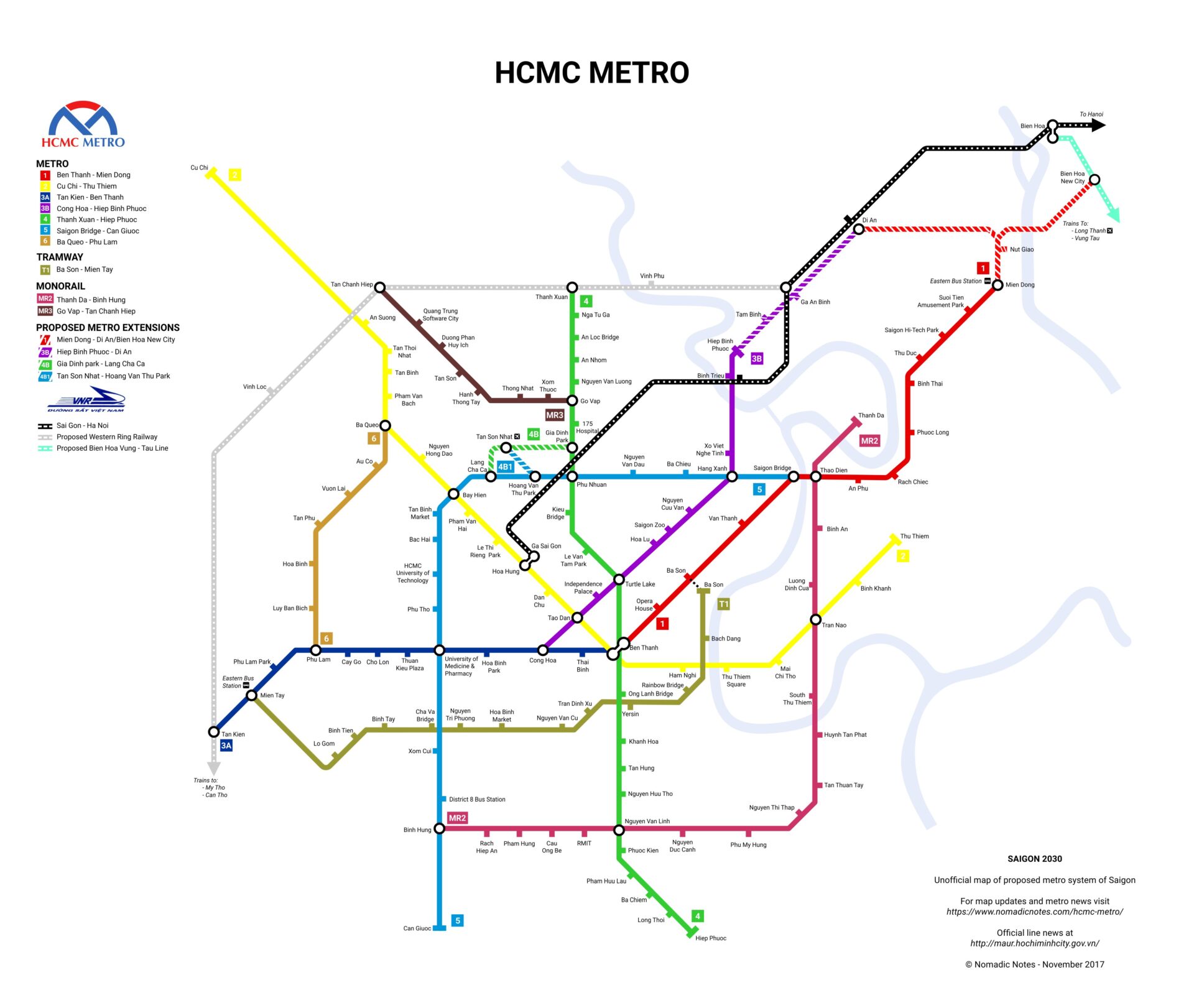
From 2025 to 2035, the city will accelerate the development of its metro network, based on an officially approved plan to invest USD 37.15 billion into nine priority metro lines.
In addition, Metro Line 2 has now received its formal construction schedule, with groundbreaking set for January 2026.
This change will reshape mobility, real estate value, business distribution, and logistics across the greater HCMC metropolitan area.
This article summarizes the latest information, including:
- The nine priority metro lines planned for completion by 2035
- Route roles, investment scale, and expected city impact
- Key updates on Metro Line 2 and its construction timeline
- How these developments will influence urban life, real estate, and business
1. USD 37.15 Billion for Nine Metro Lines by 2035
The Ho Chi Minh City Management Authority for Urban Railways (MAUR) has announced the prioritization of nine metro lines across three administrative regions:
- Former Ho Chi Minh City: 6 lines
- Former Binh Duong Province: 2 lines
- Former Ba Ria–Vung Tau Province: 1 line
Once complete, the entire system will connect the city center to major hubs including Long Thanh International Airport, national railway stations, industrial zones, and coastal port cities.
2. Six Lines in Ho Chi Minh City|The Backbone of the Future Urban Network
Line L1: An Ha – Suoi Tien (approx. 40.8 km)
Investment: USD 3.28 billion, 30 stations
A major east–west corridor that extends the existing Line 1 core into wider suburban areas.
Line L2: Thu Thiem – Cu Chi (approx. 62.2 km)
Investment: USD 2.77 billion, 42 stations
A strategic line linking the emerging Thu Thiem New Urban Area with the historic Cu Chi district in the northwest.
Line L3: An Ha – Hiep Binh Phuoc (approx. 45.8 km)
Investment: USD 5.05 billion
Part of a large loop connecting the western and northeastern districts, functioning as a major cross-city connector.
Line L4: Dong Thanh – Hiep Phuoc (approx. 47.3 km)
Investment: USD 5.96 billion
A north–south axis connecting industrial and port zones along the southern corridor.
Line L6: Inner Ring (approx. 53.8 km)
Investment: over USD 8 billion
A circular line linking all radial metro routes, designed to be the system’s main interchange backbone.
Thu Thiem – Long Thanh Airport (approx. 41.8 km)
Investment: USD 3.21 billion
The future primary airport rail link connecting central HCMC with Long Thanh International Airport.
3. Two Lines in Binh Duong Province|Strengthening Regional Commuting
BD Line 1: Binh Duong New City – Suoi Tien (approx. 32.4 km)
Investment: USD 2.27 billion
Direct connection to HCMC Metro Line 1, improving commuting between Binh Duong’s new city center and Thu Duc City.
BD Line 2: Thu Dau Mot – HCMC (approx. 21.9 km)
Investment: USD 2.27 billion
A key artery linking the provincial capital with HCMC, boosting connectivity for industrial parks and business zones.
4. One Line in Ba Ria–Vung Tau|Connecting Tourism, Industry, and Ports
VT Line 3: Vung Tau – Ba Ria – Phu My (approx. 63 km)
Investment: USD 4.83 billion
A strategic corridor planned to link the tourism city of Vung Tau with major port and industrial zones.
A connecting branch to Long Thanh Airport (approx. 23 km) is also proposed.
5. Metro Line 2 Is Finally Moving|Groundbreaking on January 15, 2026
In November 2025, the HCMC People’s Committee officially approved the construction plan for Metro Line 2 (Ben Thanh – Tham Luong).
The timeline is now confirmed:
- January 15, 2026: official groundbreaking
- January 16, 2026 onward: full-scale construction
- September–November 2030: test-run period (3 months)
- December 2030: targeted opening
This marks the long-awaited transition from planning to actual construction.
6. Metro Line 2 Technical Overview
Phase 1
Length: 11.6 km
Stations: 11 (9 underground, 1 elevated)
Serves the key corridor from central District 1 toward the northwest gateway.
Planned Route (Central D1 → Northwest HCMC)
- Ben Thanh Station (transfer with Line 1)
- Tao Dan Park
- Dan Chu
- Hoa Hung
- Le Thi Rieng
- Phan Van Hai
- Bay Hien
- Nguyen Hong Dao
- Phan Van Bac
- Tan Binh
- Tham Luong Depot
The alignment follows major congested corridors such as Cach Mang Thang Tam, Truong Chinh, and Cong Hoa, providing significant traffic relief.
7. New Funding Mechanism|Shift from ODA to Public Investment
Based on Resolution 188/2025/QH15 passed by Vietnam’s National Assembly, Metro Line 2 will move from ODA-based financing to full public investment funded by HCMC’s budget.
Key advantages include:
- Faster administrative processes
- Reduced external approval dependencies
- More stable and flexible budget execution
This shift is expected to substantially accelerate implementation speed.
8. The “60-Day Sprint” in 2025
MAUR has announced a 60-day end-of-year campaign to finalize all remaining pre-construction procedures by December 2025, including:
- Updated feasibility study (FS) approval
- Environmental Impact Assessment (EIA)
- Funding framework conversion to public investment
- Finalization of technical standards and bidding methods
- Establishment of project supervision and management structures
When completed, the project will be fully ready for construction launch in early 2026.
9. How the Metro Network Will Transform the City
1. Ben Thanh will evolve into HCMC’s strongest transportation hub
An interchange between Line 1, Line 2, buses, and future airport rail.
2. Residential demand will rise along Line 2
Areas such as Cong Hoa and Truong Chinh will see increased livability as traffic congestion decreases.
3. Long Thanh Airport connections will reshape eastern HCMC
Thu Duc City and Thu Thiem are expected to grow as airport-linked urban nodes.
4. Industrial and port clusters will gain efficiency
Hiep Phuoc and Phu My industrial zones will benefit from improved logistics flows.
5. Vung Tau and coastal cities will gain stronger tourism and cargo links
The VT Line will integrate tourism, ports, and industry into a unified regional rail network.
10. Conclusion|Ho Chi Minh City Will Become One of Southeast Asia’s Most Connected Metro Cities by 2035
With nine priority lines worth USD 37.15 billion and Metro Line 2 entering construction in 2026, HCMC is undergoing a historic transformation.
By 2030–2035, the city will evolve into a rail-connected metropolitan hub, improving mobility, reducing congestion, elevating real estate values, and expanding opportunities for tourism, logistics, and business.
The next decade represents the beginning of a new urban chapter for Ho Chi Minh City.