Living in Vietnam During Rainy Season: 20 Practical Items and Lifehacks for Heat, Humidity and Sudden Showers (2026 Expat Guide)
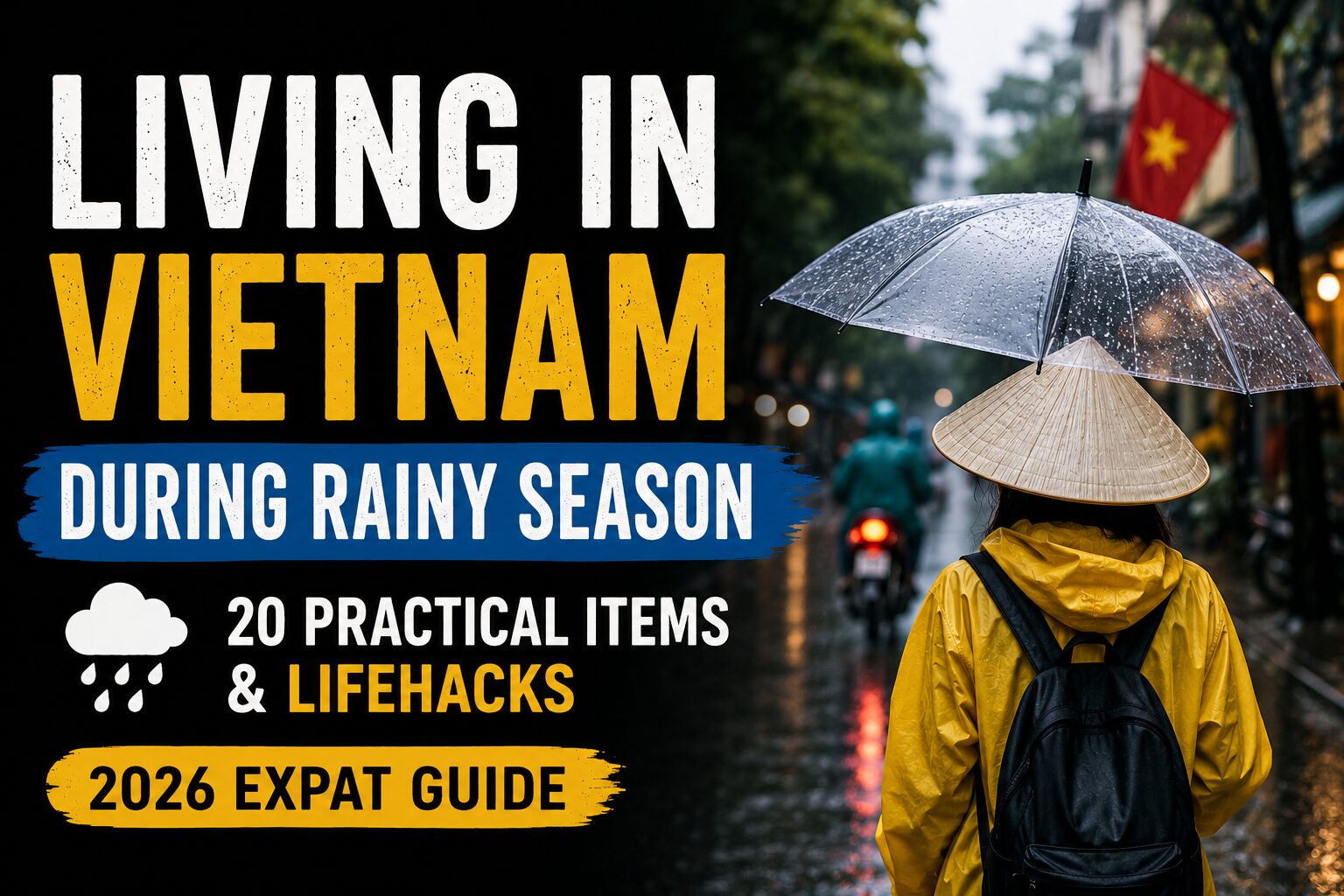
Vietnam’s southern rainy season kicks in by late May, and every newcomer asks the same question in their first week: “is it really like this every day?” The combination of 80%+ humidity, sudden tropical storms, and intense afternoon heat is genuinely overwhelming at first. But after a year on the ground, experienced expats and long-term residents have built up a quiet body of knowledge — gear lists, lifehacks, neighborhood-specific intuitions — that turn the rainy season from an enemy into “the cool, quiet season.” This guide compiles what foreign residents in Ho Chi Minh City, Hanoi, and Da Nang actually do, with 20 specific items you should own.
Key takeaways
✅ Vietnam’s rainy seasons: South May–November, North May–September, Central September–January. Regional differences are huge.
✅ Seven challenges every expat faces: mold, AC sickness, undryable laundry, blackouts, flooded streets, motorbike accidents, and dengue.
✅ 20 essential items in 6 categories: dehumidifiers, rain gear, cooling gear, laundry care, mosquito defense, footwear and health.
✅ Three rules for storm days: check the weather app, carry a poncho, and choose indoor waiting over Grab when the storm is short.
✅ Dengue prevention: long sleeves and DEET-based repellent during dawn (6–10 a.m.) and dusk (4–8 p.m.) cut your risk by more than 90%.
Vietnam’s rainy season: north, central, south are not the same
A common newcomer mistake is treating “Vietnam’s rainy season” as a single concept. In reality, the timing and character vary dramatically depending on where you live.
| Region | Rainy season | Rain pattern | Main expat headache |
|---|---|---|---|
| South (HCMC, Mekong) | Late May–Nov | Intense afternoon storms (30–60 min) | Street flooding, motorbike accidents |
| Central (Da Nang, Hue) | Sep–Jan | Typhoons + prolonged rain | Blackouts, floods, water cuts |
| North (Hanoi, Hai Phong) | May–Sep | High humidity + short cloudbursts | Mold, AC sickness, fatigue |
Southern Vietnam in particular follows a very predictable rhythm: morning is sunny, a sudden storm hits between 3 and 5 p.m., and by sunset it is clear again. Once you internalize this, you stop letting “the rainy season” dictate your life.
The 7 challenges every Vietnam expat learns the hard way
Based on a 2025 community survey of 100 foreign residents in HCMC and Hanoi, these are the seven problems that came up most often.
- Mold: leather, sofas, closets, bathrooms, and AC interiors. Once mold takes hold, removing it takes a week or more.
- Health issues: “AC sickness” (autonomic-nervous-system strain from 14°C temperature differences), humidity fatigue, food poisoning spikes.
- Laundry that never dries: outdoor drying is impossible. Even indoors, clothes take 48 hours and develop a sour smell.
- Blackouts: more common in central and northern Vietnam — typically 1–3 hours, 5–10 times a year, often during thunderstorms.
- Street flooding: knee-deep water in parts of HCMC Districts 1 and 3, and the Hanoi Old Quarter.
- Motorbike accidents: emergency-room visits in HCMC rise 1.5× during the rainy season (HCMC emergency medical data).
- Dengue fever: peaks June–September. HCMC reported ~7,000 cases in 2024.
20 essential items for living in Vietnam during rainy season
Here are the 20 items most highly rated by long-term foreign residents, organized into 6 categories. Every product on this list can be sourced inside Vietnam.
Category A | Dehumidifiers and mold control (4 items)
| 1. Dehumidifier (Máy hút ẩm) The single most important investment for life in 80%+ humidity. Aim for a 10+ L/day model. Price: 5–15 million VND (USD 200–600) Where to buy: Điện Máy Xanh, Nguyễn Kim, Lazada, Tiki Pro tip: Ideally run one each in your living room, bedroom, and closet. Japanese brands (Sharp, Panasonic) are widely available. |
| 2. Closet dehumidifying packs (Hút ẩm chống mốc) Calcium-chloride dehumidifying packs for closets, drawers, shoe cabinets. Price: 40,000–120,000 VND each (USD 1.6–5) Where to buy: WinMart, AEON, Lotte Mart, Daiso, Mumuso Pro tip: Replace every 6 months. Combine with silica gel for cameras, leather, and electronics. |
| 3. Bulk silica gel (Hạt hút ẩm) Reusable orange silica gel for cameras, electronics, and leather. Heat in microwave to regenerate. Price: 50,000–150,000 VND / 500g (USD 2–6) Where to buy: Shopee, Lazada, local camera shops Pro tip: When the orange beads turn brown, regenerate in microwave for 2–3 minutes. |
| 4. Mold remover spray (Xịt tẩy mốc) For bathrooms, kitchens, and tile grout. Vietnamese brands work fine. Price: 80,000–180,000 VND (USD 3.2–7.2) Where to buy: WinMart, Bach Hoa Xanh, Co.opmart Pro tip: Chlorine-based — ventilate well. Never use on leather (it bleaches). |
Category B | Rain gear (4 items)
| 5. Lightweight motorbike poncho (Áo mưa cánh dơi) Essential for anyone on a motorbike. Vietnam’s signature “bat-wing” hooded design covers rider, passenger, and bag. Price: 30,000–150,000 VND (USD 1.2–6) Where to buy: Street stalls, convenience stores during rainy season, supermarkets Pro tip: Choose neon yellow or green for visibility. Size L covers both rider and backpack. |
| 6. Storm-proof compact umbrella (Ô gấp chống gió) Wind-resistant reverse-fold design with fiberglass ribs. Price: 150,000–400,000 VND (USD 6–16) Where to buy: Decathlon, Muji, Daiso Pro tip: Decathlon’s monsoon-rated umbrellas outperform most consumer Japanese umbrellas in real Vietnam storms. |
| 7. Waterproof dry bag (Túi chống nước) IPX6 roll-top dry bags for phone, wallet, passport. Price: 100,000–350,000 VND (USD 4–14) Where to buy: Decathlon, Shopee, Lazada Pro tip: Carry both a small 5–10L for daily use and a 30–40L cover for your work backpack. |
| 8. Phone waterproof pouch (Bao chống nước điện thoại) PVC pouch on a lanyard — operate Grab and maps even in a downpour. Price: 30,000–80,000 VND (USD 1.2–3.2) Where to buy: Daiso, Mumuso, Shopee Pro tip: Always test in a sink before use. Cheap versions sometimes seal poorly. |
Category C | Heat management (4 items)
| 9. Rechargeable handheld fan (Quạt cầm tay) Look for 10,000mAh+ USB-C models. Air movement is the real game-changer in high humidity. Price: 150,000–500,000 VND (USD 6–20) Where to buy: Shopee, Lazada, AEON Pro tip: Quieter Japanese-brand models for offices; higher-power local brands for outdoors. |
| 10. Cooling towel (Khăn lạnh nhanh khô) Wet, wring, snap — instant cold. Local residents wear them around the neck on motorbikes. Price: 50,000–150,000 VND (USD 2–6) Where to buy: Decathlon, Daiso, AEON Pro tip: Pro move: clip one to your bag with a carabiner so it is always with you. |
| 11. Desk fan (Quạt để bàn) Lets you keep AC at 28°C and still feel comfortable, saving electricity. Price: 200,000–700,000 VND (USD 8–28) Where to buy: Điện Máy Xanh, Nguyễn Kim, Lazada Pro tip: USB-powered options keep working during blackouts via laptop power. |
| 12. UV-blocking hat or umbrella (Mũ chống nắng / Ô chống nắng) UV is brutal even during rainy-season sunny breaks. Local women rely heavily on parasols. Price: Hat 100,000–350,000 VND / Parasol 300,000–800,000 VND Where to buy: Takashimaya, Muji, Decathlon Pro tip: Best-quality items are still cheaper to buy on Japan trips. Stock up when home. |
Category D | Laundry care (3 items)
| 13. Quick-dry clothing (Quần áo nhanh khô) Uniqlo AIRism and Decathlon sportswear are the go-to. Indoor-drying time drops to half a day. Price: Shirt 250,000–450,000 VND / Pants 400,000–800,000 VND Where to buy: Uniqlo (Hanoi & HCMC), Decathlon, H&M Pro tip: Expat staple — most residents own 3–5 quick-dry shirts for daily rotation. |
| 14. Clothes dryer (Máy sấy quần áo) Rainy-season MVP. Heat-pump models 8–10kg cost about 30,000 VND (USD 1.2) per load to run. Price: 15–30 million VND (USD 600–1,200) Where to buy: Điện Máy Xanh, Nguyễn Kim, imported appliance shops Pro tip: Confirm your apartment can support dryer installation (ventilation, drainage) before buying. |
| 15. Fabric refresher spray (Xịt khử mùi quần áo) Vietnamese Febreze or Muji mist for the sour smell of incompletely dried clothes. Price: 90,000–250,000 VND (USD 3.6–10) Where to buy: WinMart, AEON, Muji, Daiso Pro tip: Stock one large bottle before season; you will use it more than you expect. |
Category E | Mosquito defense (2 items)
| 16. Mosquito repellent spray (Xịt chống muỗi) Soffell (Indonesian) and Remos (Vietnamese) are the local standards. DEET-based for serious protection. Price: 40,000–120,000 VND (USD 1.6–5) Where to buy: WinMart, pharmacies, convenience stores Pro tip: DEET 12%+ for daytime outdoor (8-hour protection). Essential-oil based for indoor short-term use. |
| 17. Plug-in mosquito vaporizer (Máy đuổi muỗi) Liquid-vaporizer plug-in units. One unit covers a 10–15 m² bedroom. Price: Device 100,000 VND / Refill 60,000 VND (USD 4 / 2.4) Where to buy: WinMart, pharmacies, Shopee Pro tip: JUMBO Vape (local) and Earth (Japanese-licensed) both work well. Essential for dengue prevention. |
Category F | Footwear and health (3 items)
| 18. Waterproof sandals (Dép chống nước) Crocs and Decathlon trekking sandals dry fast and don’t slip on flooded streets. Price: 200,000–800,000 VND (USD 8–32) Where to buy: Crocs flagship, Decathlon, airport duty-free Pro tip: Two pairs is ideal — office-friendly leather-look Crocs for work, full waterproof TEVAs for storms. |
| 19. Oral rehydration drinks (Nước bù điện giải) Vietnam’s Pocari Sweat equivalent (Aquarius). Important for heat-induced dehydration and post-storm body cooling. Price: 15,000–25,000 VND (USD 0.6–1) Where to buy: Convenience stores, WinMart, Bach Hoa Xanh Pro tip: Keep a few cold in the fridge for sudden heat exhaustion. Powder sachets are great for stockpiling. |
| 20. Dengue prevention kit (Bộ chống sốt xuất huyết) Long-sleeve quick-dry shirt + long pants + DEET spray + acetaminophen stockpile. Critical during dawn and dusk mosquito hours. Price: Long-sleeve shirt 200,000–400,000 VND (USD 8–16) Where to buy: Uniqlo, pharmacies Pro tip: Vietnam approved a dengue vaccine in 2024 — worth one vaccination as a long-term resident. |
Storm-day transit: three rules every resident follows
When a storm hits mid-day, your decision — move now, wait, or change transport — is where experienced residents really earn their stripes. The following three rules come up over and over again in community discussions.
Rule 1: If you can wait 30 minutes, wait indoors
Vietnam storms typically last 30–60 minutes. Stepping into a café or shopping mall is almost always the safest, fastest, and least-stressful response. Long-term residents keep a mental list of indoor refuges within 500m of their home and office.
Rule 2: If you have to move, use Grab Car (not GrabBike)
Motorbike taxi rides during storms are dangerous and 2–3× more expensive due to surge pricing. Booking a Grab Car or Be Car is the right call. Expect 20–40 minute wait times during peak storm hours, so plan ahead.
Rule 3: Track the 30-minute forecast with a weather app
Windy, Weather Underground, and the official Vietnam meteorology app are the local favorites. Shifting your departure by 15–30 minutes based on a 30-minute forecast is often the difference between a dry trip and a soaked one.
5 rainy-season mistakes new residents always make
First-year regrets — learn from your seniors
✅ Leaving high-floor windows open when you leave the apartment — sudden storms blow rain in from balconies and flood your living room.
✅ Leaving leather shoes and bags out — by morning they are spotted with white mold. Stuff with silica gel or use a dry cabinet.
✅ Setting AC below 26°C overnight — leads to “AC sickness” (autonomic dysregulation). 28°C plus a fan is the local move.
✅ Sheltering under street trees during storms — risk of lightning and downed wires. Always head into a building.
✅ Eating street food immediately after a storm — rainwater can mix with prep surfaces. Wait 1–2 hours or go indoors.
Rainy season health: food poisoning, dengue, AC sickness
Food poisoning prevention
Rainy-season heat and humidity spoil food 2–3× faster than dry season. Keep your fridge at 5°C or below, avoid raw vegetables and ice at street stalls, and stick to bottled water. Carry digestive medicine (charcoal tablets, probiotic supplements) at all times.
Dengue prevention
The dengue mosquito (Aedes aegypti) is active 6–10 a.m. and 4–8 p.m. Long sleeves plus DEET-based repellent during those hours cuts infection risk by more than 90%. Symptoms are sudden high fever (close to 40°C), severe headache, and joint pain for 3–7 days. If you suspect dengue, get to a foreigner-friendly hospital quickly — Vinmec in HCMC, Raffles Medical in Hanoi.
AC sickness
A 35°C outside / 22°C inside swing throws off your autonomic nervous system. Headache, lethargy, joint pain are common. Set AC to 28°C, run a fan with it, drink water before going out, and have one warm drink a day.
Turning the rainy season into a season you actually like
Rainy season is also the season residents enjoy parts of Vietnam they couldn’t enjoy when tourists are everywhere. Tourist hotspots empty out, hotels and spas drop prices, and you finally have indoor time for habits you have been putting off.
- Café work: the cafés around Hoan Kiem Lake and Thao Dien finally have empty seats.
- Reading and films: most expats average 5 books and 10 films per month during rainy season.
- Spa days: many premium spas (Anam Spa, La Maison de Tan My) offer expat-only rainy-season discounts.
- Domestic travel: central Vietnam (Da Nang, Nha Trang) is at peak dry season in June — perfect weekend escape.
- Hobbies and classes: Japanese Chamber of Commerce in Vietnam (JCCH) and similar organizations cluster classes in the rainy season.
FAQ: Vietnam rainy season for foreign residents
Q1. When does the southern Vietnam rainy season actually start?
A. Late May reliably, peaking July to September, and tapering into early November. Most days are not rain-all-day — they’re sunny mornings followed by intense afternoon storms lasting 30–60 minutes.
Q2. What is the realistic dengue risk for residents?
A. HCMC reported about 7,000 cases in 2024 against a city population of 9 million — roughly 0.08% per year. Inside the expat community, a rough rule is “you or someone you know will catch it within three years.” Severity is generally moderate with proper hydration and care, but a small percentage of cases need hospitalization.
Q3. What do long-term residents say is the most important pre-season purchase?
A. Two answers come up the most: a dehumidifier and a clothes dryer. After that: waterproof sandals, a quality handheld fan, and DEET-based repellent. Items most people say “I shouldn’t have shipped from home”: ponchos and basic mosquito coils — local versions are better and cheaper.
Final word: the rainy season is a friend once you learn its rhythms
Vietnam’s rainy season is a stumbling block in your first year and an old friend by your third. The keys are knowing your region, equipping yourself with the right local gear, and developing storm-day instincts that let you keep living a normal life around the weather.
Treat this guide as a printable household checklist for June — the rainbow after a storm, the smell of clean air, and the quiet afternoon hours of indoor rain are uniquely Vietnamese rewards for the prepared.